

Why We Read
What happens when you stop trying to get something out of every book.


We tend to think about reading in terms of usefulness.
In school, we’re asked to write reports and take tests to prove comprehension. As adults, we usually follow one of two paths: we stop reading altogether, or we select books based on their utility.
That framing is too narrow. It’s the wrong lesson. The point of reading isn’t to change what you know. It’s to change how you think.
Reading for utility sounds reasonable. Correct, even. That’s the rub.
The irony is that reading to acquire knowledge can actually work against learning.
When acquisition is the driver, you read quickly, skimming pages for surface level insights. You can get through more content, but you don’t truly engage with or contemplate ideas.
Without realizing it, you focus on memorizing facts, confusing retention with understanding. We’ve all crammed for a test that way, only to find that the material is out of our brain faster than it entered. Memorization feels like learning, but it’s not the same.
You also limit what you read. The majority of works are off the table immediately, leaving only a handful of books in related subjects. Even if you expand the filter, you’re likely to select things that are safe and easy to consume. There’s no room for new ideas that challenge or expand your thinking.
And again, learning, in the conventional sense, isn’t the purpose.
I used to exclusively read books about sports front offices.1 Eventually, I broadened my criteria to include adjacent topics like decision-making and communication — as long as the books covered something that could reasonably apply to my professional life.
Where that standard came from, I couldn’t tell you.
I know I didn’t enjoy reading in school. It was mandatory. Teachers selected the books.2 And I felt forced to adopt consensus views rather than come up with my own thoughts.
When I got older, I found reading to be more enjoyable, but it was still homework in many ways.
It wasn’t until a few years ago that I redefined my own purpose. For me, it began with reading more fiction. I had always treated fiction as taboo because I couldn’t see how it would enhance my career. What I didn’t realize — obvious as it now seems — is that my thinking wasn’t only wrong, but it also didn’t matter. Novels transport you to different worlds. They take you inside the minds of other people. They ignore conventional rules and push the boundaries of what is possible.
At first, it felt strange reading things that weren’t directly useful. I may have even felt guilty. Slowly, I began to see that there might be a different way to approach reading.
I could tell you that shifting purpose comes with a host of benefits related to learning and growth. It allows for slower, more reflective reading and sparks connections that didn’t previously exist.
But — and I can’t stress this enough — that isn’t the point.
Instead, I’ll tell you that when you let go of the need to take something away from everything you read, something cool happens.
Sometimes you’ll read something and learn.
Other times you’ll read something and feel a certain way, a certain emotion.
Occasionally, you’ll read something and find it’s not for you.
In every instance, you’ll be different when you finish reading than when you started. Not necessarily noticeably different (which would be exhausting for you and everyone around you), but in small, almost imperceptible ways. Your thinking will evolve because you opened yourself up to something new, regardless of what exactly happened as a result.
Think about it. The best books you’ve ever read, are they really the ones you remember perfectly? That you can quote line for line?
We love books that expand the way we think, for a variety of different reasons. That’s enough.
The other great thing about redefining purpose — it doesn’t actually have to change what you read. Every book you could possibly select when reading for utility remains available when you shift your mindset.
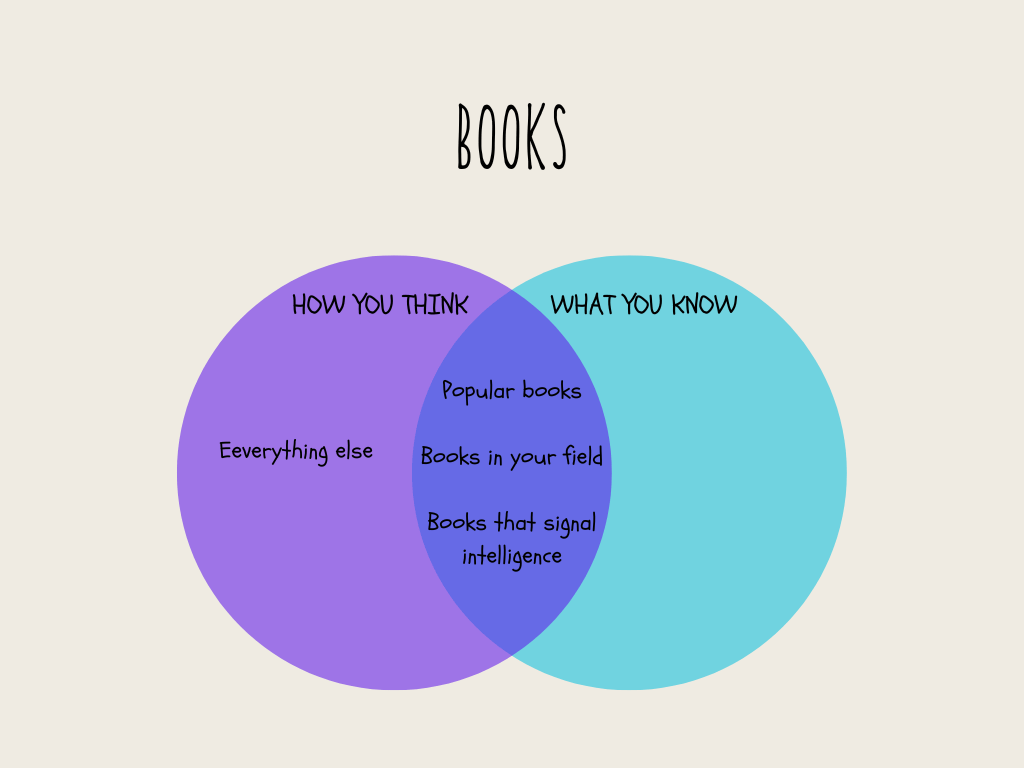
I still read a lot of books about decision-making, learning, and communication. I also read memoirs, novels, and oral histories of emo’s mainstream explosion. Everything is on the table.
Reading is often seen as a sign of intelligence, drive, and status.
I realize now that I was reading for me, but I was also doing it to support my identity. To offer opinions where I hadn’t yet formed my own thoughts. To not be excluded from conversations.
I was reading out of obligation, acting based on what I should do, not what I wanted to do. And that obligation was entirely self-inflicted, which is the worst kind of obligation.
Once I realized what I was doing, I made a tiny reframe. A reframe that changed how I think about reading. Maybe it will do the same for you.
Fortunately, in this case, there aren’t that many compelling titles about the inner workings of professional sports teams. After Moneyball, the broad appeal falls off a cliff.
I didn’t like most of the books we read at my high school. The only two I enjoyed were Brave New World and A Separate Peace.